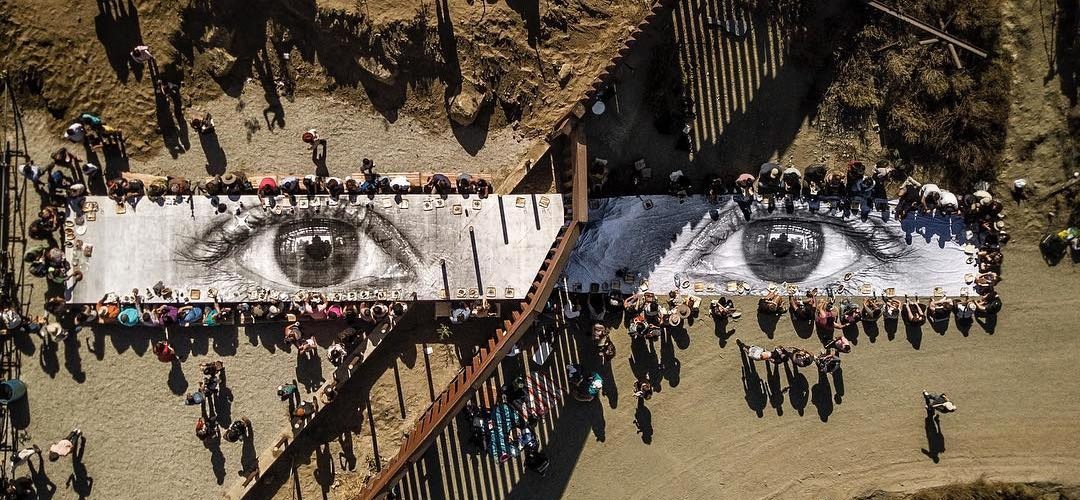
Image: JR, “Migrants, Mayra, Picnic across the border, Tecate, Mexico – U.S.A., 2017.”
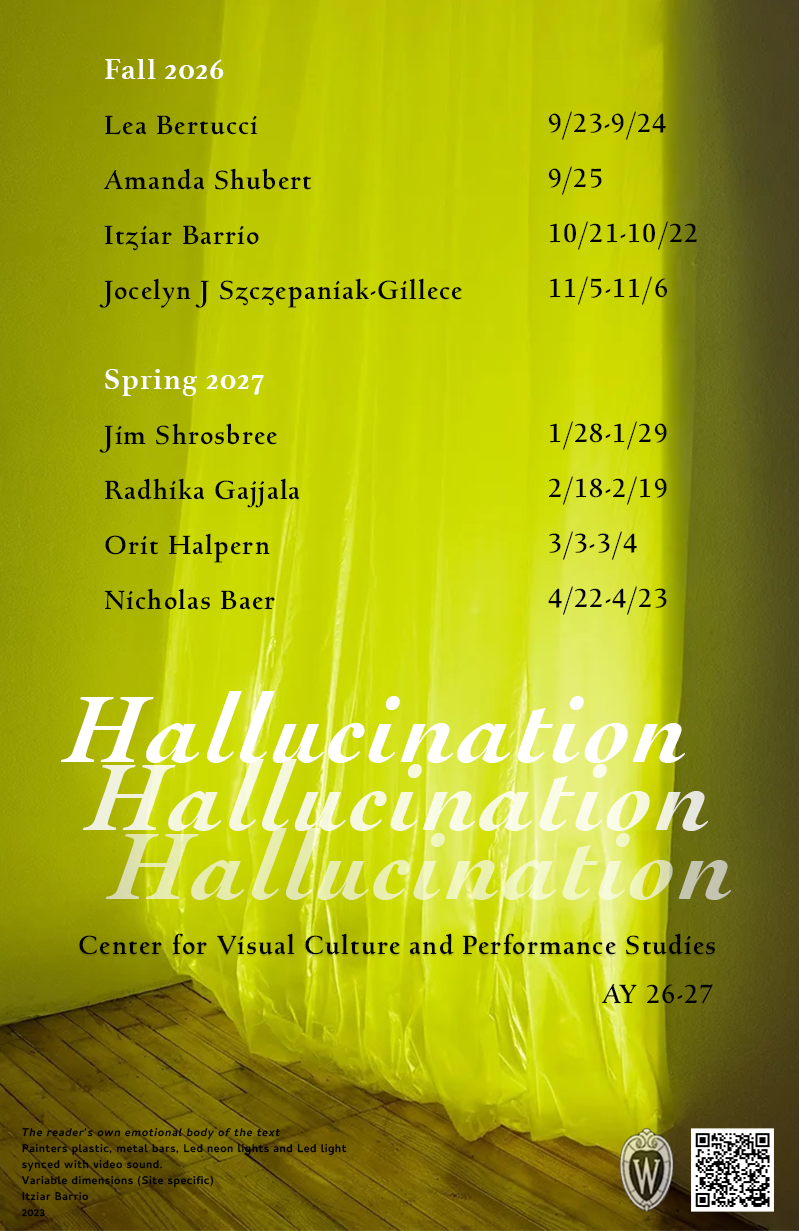
Hallucination
Hallucination names a phenomenon increasingly on everyone’s brains: AI-driven content that is flagrantly inaccurate, yet asserted with utter certainty, resembling what a human might write, say, or see. Today inseparable from generative AI as well as social media worlds and their uncanny doppelganger effects, hallucination identifies — both technically and critically — a powerful media effect, a visual and verbal subterfuge. Yet it also invokes a world-building potential, at once dangerous and powerfully productive. Arguably, this dual edge has been present long before AI. Media theorists, artists, and art historians have been particularly attuned to the powers of hallucination. The phenomenon of anamorphosis has been generative for theorists in and beyond the visual arts, while scholars of early image technologies have debated the extent to which projected images and the phantasmagoria of everyday life could instigate viewers to lose their bearings in the world. Hallucination has been marshalled to critique the powerful mass effects of media in Guy Debord’s society of the spectacle and Jean Baudrillard’s analysis of hyperreality and simulation. Meanwhile, the influential contemporary visual artist and media theory Hito Steyerl has been rethinking spam, AI-slop, and the implications these contemporary phenomena have for the gallery space and the very notion of the artwork.
Our programming for this academic year features artists, scholars, and artist-scholars exploring both the pitfalls and generative dimensions of hallucination through the transdisciplines of visual cultures and performance studies. We invite scholars, students and the greater community to collaborate on this year-long inquiry into hallucinations throughout history and the globe — sharpening their critical edge in a present of distorted worlds.
CVCPS FALL 2026 PROGRAMMING
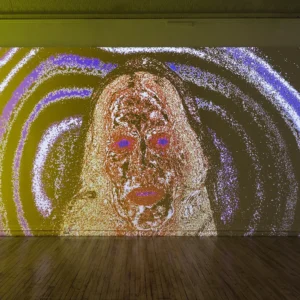
9/23 Artist Talk: A Primeval Future: The Process of Creating The Days Pass Quickly Immersed in the Shadow of Eternity
9/24 Performance
9/25 Workshop: The Virtual Image: A Media Archaeology Workshop

WHO ARE WE?
Created out of an innovative cluster hire in 2002, the CVCPS supports curricular innovation and interdisciplinary collaboration from faculty and graduate students in visual cultures and performance studies across an unusually wide range of departments and units on campus. We sponsor a yearlong series of lectures and workshops by renowned artists and scholars focusing on themes of vital interest to our publics, and we invite members of the community and the university to meet visiting speakers, participate in events, exhibits, performances, and workshops. We also organize events and do outreach to disseminate and highlight the dynamic, transdisciplinary work of our faculty affiliates and graduate students. Housed in the College of Letters and Sciences, the Center has a network of affiliates and graduate students that spans dozens of departments, units, and colleges, sustaining a robust intellectual community necessary for advanced research, professional training, and critical engagement in and beyond the classroom. Emphasizing both the global and the local, together we explore how methods, concepts, and practices in the visual arts and performance help us understand our world.
WHY STUDY VISUAL CULTURES?
Visual literacies and performance methods are arguably among the most important skills for students to develop. While the study of visual cultures is an interdisciplinary field in its own right, its rise as a field stems our image-dominated world. A demonstrated capacity to analyze critically and creatively in the realms of visuality and performance affords opportunities for students in a wide range of traditional disciplines from Anthropology to History to English as well as the interdisciplines of Design Studies, African Cultural Studies, and Gender and Women’s Studies, and more. As the world continues to become increasingly understood through, the visual and performance (films, television, data visualization, video games, and advertisements, social media) training in interpreting, creating, and evaluating those mediums is increasingly essential.
MINOR & CERTIFICATE
We offer a Doctoral Minor and a Graduate Certificate for masters and professional students. Students enrolled in a terminal M.A. or M.F.A. program are eligible for a Graduate Certificate whereas Ph.D. students are eligible for a Doctoral Minor.
DIVERSITY, EQUITY, AND INCLUSION STATEMENT
The Center for Visual Cultures and Performance Studies seeks to join and shape a community in which individuals of any gender, race, ethnicity, caste, ability, religious affiliation, sexual orientation, cultural upbringing, language variety, and socioeconomic standing may flourish. Our programming reflects this commitment. We welcome diverse perspectives, especially of those who are marginalized or vulnerable members of society, and seek to place international perspectives in dialogue with national ones.
FACULTY SPOTLIGHT

(Associate Professor, Dance Department)
See here for more faculty accomplishments.